Prognostic impact of kidney function before transcatheter aortic valve implantation: A nationwide study
European Heart Journal - Valvular and Structural Heart Disease


Abstract
Prognosis after transcatheter aortic valve implantation (TAVI) keeps improving, yet some high-risk groups persist, with chronic kidney disease being one. Contemporary data on the prognostic importance of pre-TAVI kidney function are sparse, leaving uncertainty regarding which patients derive limited benefit from TAVI.
To assess the association between pre-procedural kidney function and long-term outcomes in TAVI patients.
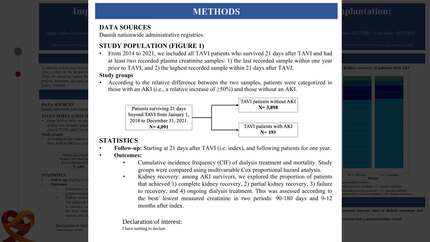
We used Danish nationwide registries to identify patients with aortic stenosis undergoing TAVI between 2015 and 2022. Patients were categorized by baseline eGFR into ≥60, 30-59, and <30 mL/min/1.73 m2 or recent dialysis. We examined one-year all-cause mortality and hospitalization burden after TAVI and estimated relative risks using multivariable Cox and logistic regression.
We included 3888 (60.7%) patients with eGFR ≥60 (58.4% male; median age, 80 years), 2185 (34.1%) with eGFR 30‐59 (55.5% male; median age, 83), and 336 (5.2%) with eGFR <30 or recent dialysis (58.0% male; median age, 81).
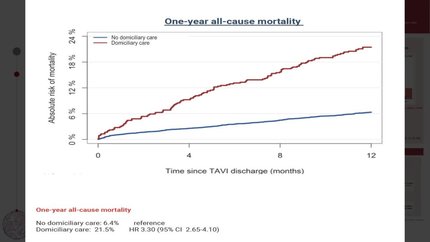
One-year cumulative incidence of all-cause mortality was 5.6% for eGFR ≥60, 9.1% for eGFR 30–59, and 19.6% for eGFR <30 or dialysis. Adjusted hazard ratio was significantly higher for eGFR 30–59 (aHR, 1.45; 95% CI, 1.19–1.78, p =0 .0003) and eGFR <30 or dialysis (aHR, 3.07; 95% CI, 2.32–4.08, p < .0001) than eGFR ≥60. Cumulative rehospitalization exceding14 days after TAVI was most frequent among patients with eGFR <30 or dialysis (18.4%).
We observed a stepwise association between pre-TAVI kidney function and post-TAVI one-year mortality as well as hospitalization burden. Kidney impairment potentially has substantial prognostic impact and should be incorporated into lifetime management of patients undergoing TAVI.
Contributors

Jeppe K Petersen
Author
Victoria Mikkelsen
Author

Louise Marqvard Sørensen
Author
Rigshospitalet - Copenhagen University Hospital Copenhagen , Denmark
Jonas Agerlund Povlsen
Author
Christian Juhl Terkelsen
Author

Ole de Backer
Author
Morten Schou
Author

Emil Fosbøl
Author
You may be interested in