Management of bicuspid aortic stenosis
European Heart Journal - Valvular and Structural Heart Disease


Abstract
Bicuspid aortic valve (BAV) disease is the most common congenital heart lesion and is associated with premature leaflet degeneration, aortic stenosis (AS), aortic regurgitation (AR), endocarditis, and ascending aortic pathologies. This review aims to summarize the key issues frequently associated with BAV and their impact on treatment decision-making, with a particular focus on surgical aortic valve replacement (SAVR) versus transcatheter aortic valve implantation (TAVI) in patients presenting with AS.
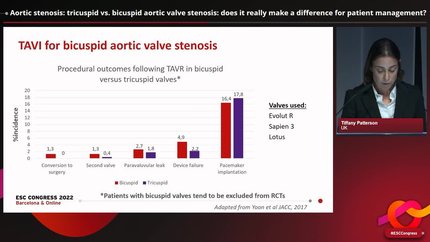
Patients with BAV experience a 70% lifetime risk of aortic valve surgery, often at a younger age than those with a trileaflet anatomy. BAV is present in up to 40% of patients undergoing SAVR, which remains the standard of care in low-risk patients. TAVI has emerged as a less invasive treatment alternative with favorable short- and mid-term outcomes in appropriately selected BAV patients. Randomized controlled trials (RCTs) comparing TAVI and SAVR have systematically excluded BAV patients, except for the UK TAVI trial and recent NOTION-2 trial, the latter signalling a potentially increased risk of all-cause mortality, stroke, and re-hospitalization rates at 1 year among low-risk BAV patients undergoing TAVI. Dedicated RCTs comparing TAVI and SAVR for BAV stenosis are in preparation and will inform future guidelines.
Treatment decisions for BAV patients should be individualized by Heart Teams, considering periprocedural risk, comorbidities, aortic root anatomy, and life expectancy. Future trials in this specific population will clarify the optimal role of TAVI and SAVR in managing BAV-related aortic stenosis.
Contributors




You may be interested in