Subcutaneous and visceral fat density is associated with long-term mortality after transcatheter aortic valve implantation
European Journal of Preventive Cardiology


Abstract
Type of funding sources: Public Institution(s). Main funding source(s): Amsterdam UMC
Despite a technically successful procedure, not all patients with severe aortic valve stenosis benefit from Transcatheter Aortic Valve Implantation (TAVI). Screening of patients at increased risk of adverse outcomes can improve treatment decisions. Studies in healthy older adults show that fat density on a Computed Tomography scan (CT) scan is a possible risk factor associated with weight loss and mortality. The association of fat density with mortality after TAVI is unknown.
The aim of this study is to investigate the association of subcutaneous and visceral fat density with long-term mortality after TAVI, in addition to known risk factors.
Patients undergoing TAVI from January 2010 to January 2020 were included. Computed-tomography (CT) scans were made in all patients as work-up for the procedure. Deep-learning-based software was used to automatically determine subcutaneous and visceral fat density on available fat tissue at the transversal slice at the height of lumbar vertebra 3 (L3), see figure 1. Association with all-cause long-term mortality was determined with Kaplan-Meier curves, log-rank tests, and adjusted Cox regression models. In all analyses, patients in the highest tertile of fat density were compared to patients in the middle and lowest tertile. Two Cox regression models were made, model one adjusted for relevant confounders: age, sex, EuroSCORE-II, New York Heart Association score, chronic obstructive pulmonary disease, left ventricular ejection fraction, transfemoral access route, body mass index, and chronic kidney disease; and model two additionally including muscle mass and muscle density.
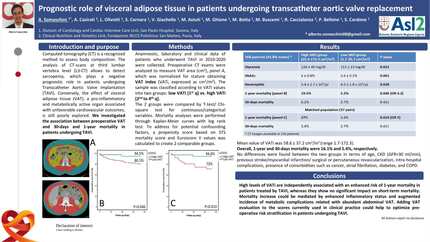
In total, 1,404 patients were included, mean age was 80 ± 7 years and 53% were female. Median long-term follow up was 1,093 [IQR: 639 – 1,602] days. Unadjusted Kaplan-Meier curves showed that both subcutaneous fat density (Figure 2, log rank p<0.01) and visceral fat density (Figure 2, log rank p<0.01) were strongly associated with mortality. In the multivariate Cox regression model one, the association remained significant with a hazard ratio of 1.46 [95%CI: 1.23 – 1.73] for high subcutaneous fat density and 1.31 [95%CI: 1.09 – 1.58] for high visceral fat density. Also, in model two fat density remained significantly associated with mortality for subcutaneous fat density HR 1.52 [95%CI: 1.28 – 1.81] and visceral fat density HR 1.41 [95%CI: 1.16 – 1.71].
High subcutaneous and visceral fat density determined on the procedural CT-scan before the TAVI are independently associated with long-term mortality. These results show that future risk models in TAVI patients should take fat density into account.
Example computed tomography (CT) scan
Kaplan Meier Curves
Contributors


You may be interested in