Unmasking the prevalence of cardiac amyloidosis in the real world: first insights from the phase 2 of the AC-TIVE study, an italian nationwide survey
European Journal of Preventive Cardiology


Abstract
Type of funding sources: Private grant(s) and/or Sponsorship. Main funding source(s): Pfizer
Clinicians need to identify patients with cardiac amyloidosis (CA) at an early stage, due to the availability of disease modifying therapies. Some echocardiographic findings may rise the suspicion of CA, also in patients with mild or no symptoms, orienting second level diagnostic tests.
To investigate the prevalence of CA in consecutive patients ≥55 years undergoing clinically indicated, routine transthoracic echocardiogram (TTE) in Italy with echocardiographic signs suggestive of CA.
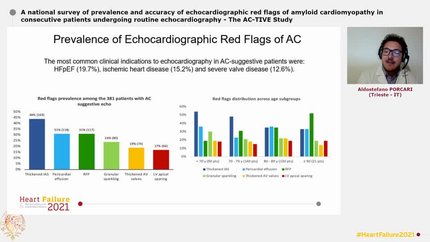
This is a prospective multicentric study conducted in Italy. It comprises two phases: 1) an observational phase consisting in a national survey on prevalence of possible echocardiographic red flags of CA in consecutive patients ≥55 years undergoing routine TTE (1), and 2) a CA diagnostic phase. Preliminary results of phase 2 are herein presented. Patients who presented a CA-suggestive TTE (i.e. at least one red flag of CA in hypertrophic, non-dilated left ventricles) in the phase 1 were further evaluated (1). Those who consented to proceed in the study, underwent clinical evaluation, electrocardiography, blood and urine tests and scintigraphy with bone tracer. Diagnosis of transthyretin related-CA (ATTR-CA) was made in presence of grade 2 -3 Perugini uptake at scintigraphy and absence of monoclonal protein. The study was registered at ClinicalTrials.gov.
Of the 5315 screened echocardiograms, 381 exams (7.2%) were classified as CA-suggestive (1). Two-hundred-twelve of the 381 patients with a CA-suggestive TTE proceeded to the phase 2 of the study. The main reasons for the 169 non-entering patients into the phase 2 were death [n=53] and refusal to participate [n=85]. Sixty-five of these 212 patients (31%; 17% considering also the 169 non-entering patients into the phase 2 and assuming they did not have CA) had a circumstantiated diagnosis of CA. In detail, ATTR-CA was diagnosed in 53 (25%) and AL-CA in 12 (5.7%) patients.
Among a cohort of consecutive unselected patients ≥55 years with echocardiographic findings suggestive of CA, the real prevalence of disease ranged from 17% up to 31%. Although ATTR-CA was predominant, AL-CA was diagnosed in a significant amount of cases. TTE has a fundamental role in screening patients, raising the suspicion of disease and orienting diagnostic work-up for CA.

You may be interested in