Exergaming in cardiac rehabilitation: a systematic review and meta-analysis
European Journal of Preventive Cardiology


Abstract
Type of funding sources: Public Institution(s). Main funding source(s): Valencia Region Innovation Agency (INNOAVI)
Cardiovascular disease (CVD) is the leading cause of death in Europe. The lack of physical activity is related to the onset of CVD. Despite the evidence of the effects of exercise-based cardiac rehabilitation (CR) on mortality risk in patients with CVD, the benefit of adding exergaming is unclear.
The aim of this systematic review and meta-analysis was to (a) summarize the characteristics of previous studies regarding exercise-based CR programmes based on exergaming and (b) determine the effects of exergaming on functional capacity (i.e., distance covered in the 6-min walk test [6MWT]) and other outcomes (i.e., quality of life and motivation).
We carried out a systematic search in PubMed, Embase, Web of Science, and Cumulative Index to Nursing and Allied Health Literature (without language restrictions) up to June 2021. Our search strategy included terms related to patients (e.g., chronic heart failure, cardiovascular disease, and coronary artery disease) and the interventions (e.g., exergaming and cardiac rehabilitation). We included controlled and uncontrolled studies and extracted data regarding the characteristics of the study, patients, and intervention. In regards to the quantitative analysis, we used the standardised mean difference (SMD) or mean difference (MD) to measure the effect size and random-effects models to perform a pooled analysis of outcomes reported in at least three studies.
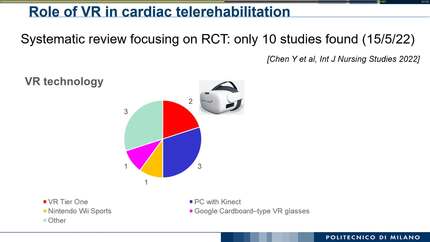
Eight studies fulfilled our inclusion criteria, of which seven were randomised controlled trials and all of them had an active control group. The studies included were published from 2006 to 2021. Three studies recruited patients with diverse diagnoses, four articles included patients diagnosed with coronary artery disease, and one study with heart failure. Five studies performed supervised training sessions. The type of VR varied between studies: four of them used Oculus glasses or 3D constructed reality in screens, three used a game console, and one combined several devices. The mean intervention length was 17 weeks and six studies performed less than four training sessions a week. There was a non-significant increase in the distance covered in the 6MWT in favour of the experimental groups compared to the control groups (MD = 13,89 m [95% confidence interval -18,01 to 45,79]). Moreover, there was no intervention effect on symptoms of depression (SMD = -0,21 [95% confidence interval = -0,56 – 0,13]).
Exergaming is feasible in patients with cardiovascular disease. However, the effects of adding VR to improve functional capacity and symptoms of depression are questionable. Future research is needed to clarify the role of exergaming in CR.
Flow Chart
6MWT Forest Plot
Contributors



You may be interested in