The SIDECAR 2.0 (S-ICD registry in European paediatric and young adult patients with congenital heart defects 2.0): an analysis of European S-ICD clinical practice and its evolution in paediatric patients
EP Europace Journal


Abstract
Subcutaneous implantable cardioverter-defibrillators (S-ICDs) are effective in patients who require protection from sudden cardiac death while avoiding the long-term risks associated with transvenous leads. However, data on their real-world performance in paediatric and young patients remain limited. This study aims to evaluate the safety and efficacy of S-ICDs in a large, multicentre cohort of paediatric and young patients across Europe, with a focus on contemporary implantation practices and clinical outcomes.
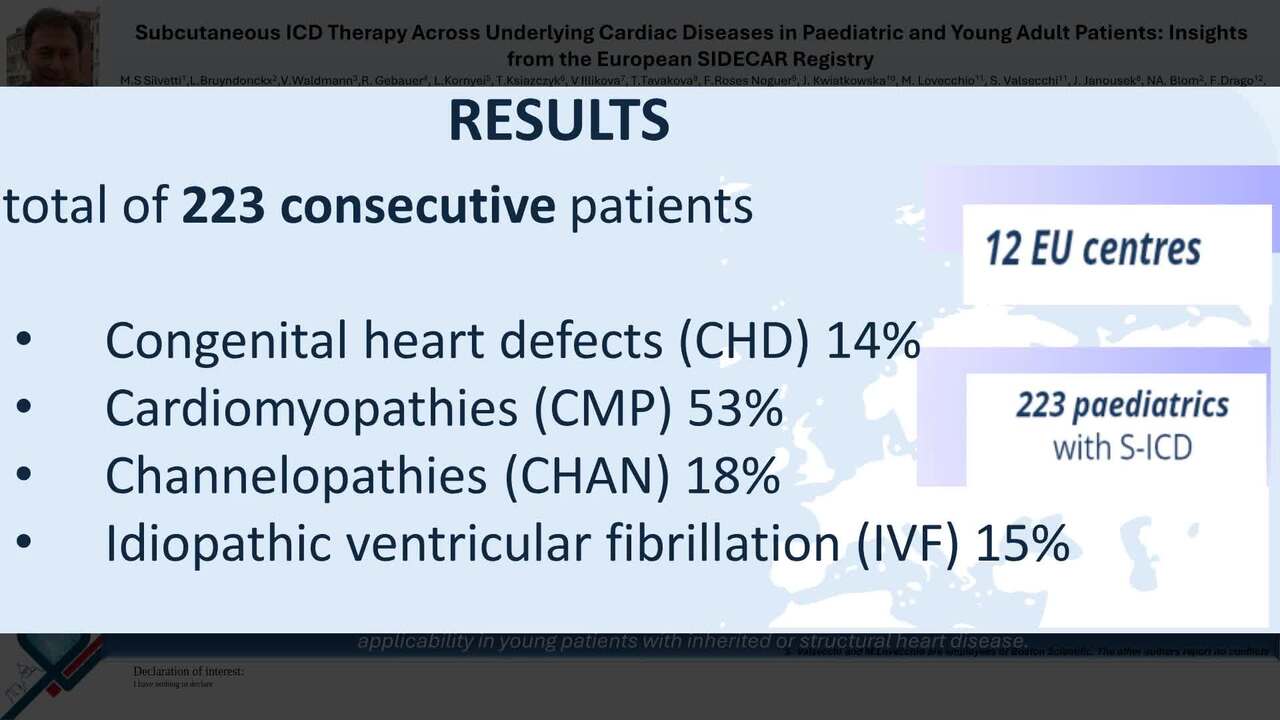
This is an international, multicentre, observational, retrospective registry on S-ICD outcome in paediatric and young adult patients with congenital heart defects (CHD), cardiomyopathies, channelopathies, and idiopathic ventricular fibrillation (IVF). Data were collected on implantation techniques, acute and long-term outcomes, including defibrillation efficacy, inappropriate (IAS) and appropriate shocks, and complications. Follow-up data were analysed to assess device performance and safety. A total of 223 patients (mean age: 15 ± 3 years; 59% male, 53% cardiomyopathies, 18% channelopathies, 15% IVF, 14% CHD) were included. Most patients underwent implantation using an intermuscular (65%) and two-incision technique (88%). Acute defibrillation success was 100%, and no intraoperative complications occurred. The median follow-up was 28 (IQR: 12–55) months. Appropriate shocks were delivered in 41 (18%) patients (26% rate at 5 years). The first shock was effective in 92% of discrete episodes. The IAS and the complication rates were 20% and 5% at 5 years. Older age, intermuscular pocket, and two-incision technique were associated with fewer complications.
This multicentre S-ICD European registry in paediatric and young patients demonstrated favourable outcomes, low IAS, and complication rates.
Contributors



Victor Waldmann
Author
Roman Gebauer
Author
László Környei
Author

Vieira Illikova
Author
Terezia Tavacova
Author
Ferran Roses-Noguer
Author
Joanna Kwiatkowska
Author
Vincenzo Pazzano
Author
Marie Wilkin
Author
Christian Paech
Author
Gábor Fésüs
Author

Piotr Wieniawski
Author

Maciej Kempa
Author
Irma Battipaglia
Author
Sophia Klehs
Author
Michal Chalupka
Author
Alice Maltret
Author
Reinoud E Knops
Author

Nico A Blom
Author
Mariolina Lovecchio
Author
Fabrizio Drago
Author
You may be interested in