Heterogeneity in clinical judgment for confirming septal lead position and capture type in left bundle branch area pacing
EP Europace Journal


Abstract
Determining lead location and confirming conduction system capture during left bundle branch area pacing (LBBAP) relies on criteria which are primarily obtained during implantation. However, the extent to which clinical judgment of the post-implant ECG varies among implanting cardiologists is unclear.
To investigate inter- and intra-observer agreement in clinical judgment of the post-implant ECG in determining lead position and conduction system capture in patients undergoing LBBAP implantation.
Unipolar paced ECGs during LBBAP implantation from 50 patients with preserved ejection fraction and baseline narrow QRS were collected. Conduction system capture was attempted in all patients and assessed using QRS morphology transitions during threshold testing following the EHRA 2023 consensus statement (gold standard). Eight experienced LBBAP-implanting cardiologists from six tertiary referral centers were asked to classify 100 ECGs, consisting of 50 unique ECGs presented twice to assess intra-observer variability. The classification included capture types (non-selective, left ventricular septal, deep septal, and right ventricular capture) and septal location (proximal left bundle, anterior-, posterior-, or septal fascicular). To assess both inter- and intra-observer variability, Cohen’s kappa statistics were employed for all possible pairs to provide a single index (Light’s kappa).
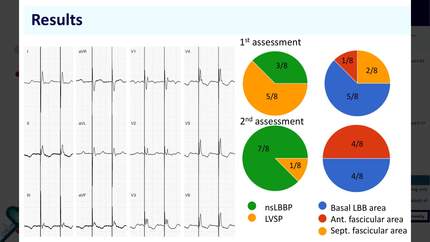
The inter-observer variability ranged from 0.255 to 0.753 (averaged Light’s kappa of 0.456 and 0.402 for the first and second ECG respectively), indicating a moderate agreement. The mean absolute inter-observer agreement for capture type was 0.689 (95% CI: 0.562 – 0.816). The intra-observer agreement for capture type was substantial, ranging from 0.398 to 0.801 (averaged Light’s kappa 0.619). There was a 72% (58-85%) concordance between clinical judgement and intra-procedural confirmation of capture type. There was moderate agreement with regards to lead location along the septum with an inter-observer agreement of 0.130 to 0.751 (averaged Light’s kappa 0.416 for the first assessment and 0.434 for the second) and an intra-observer agreement of 0.623 to 0.848 (averaged Light’s kappa 0.765) .As for capture type, the intra-observer agreement was substantial. The mean absolute inter-observer agreement for septal location was 0.568 (95% CI: 0.431 – 0.705).
The post LBBAP-implant ECG evaluation demonstrated substantial intra-observer agreement but only moderate inter-observer agreement and moderate correlation with the intra-procedural capture results in assessing capture type. As for determination of septal lead location, intra-observer and inter-observer agreement were substantial and moderate respectively. Differentiating capture types and septal lead location on ECG appears highly subjective between and within observers, highlighting the need for standardized or quantitative ECG assessment. Capture type Septal location
Contributors

J Van Koll
Author
J G L Luermans
Author
L M F Rademakers
Author
H Burri
Author
E Bressi
Author
K Curila
Author
D Grieco
Author
S M J Van Kuijk
Author
J H J Rijks
Author
K Smits
Author
J Joza
Author
K Vernooy
Author
U C Nguyen
Author
You may be interested in