Superior vena cava isolation in addition to standard pulmonary vein isolation by fourth-generation cryoballoon for paroxysmal atrial fibrillation - mid-term outcomes of a randomized trial
EP Europace Journal


Abstract
Pulmonary vein isolation (PVI) is the standard treatment for patients with atrial fibrillation (AF). Superior vena cava (SVC) is one of the most important non-pulmonary origins of AF and some studies have reported that empiric superior vena cava isolation (SVCi) could improve outcomes in ablation of paroxysmal atrial fibrillation (PAF). Nevertheless, data from randomized trials are lacking.
To evaluate the safety and efficacy of additional SVCi using a fourth-generation cryoballoon to the standard PVI in patients with PAF.
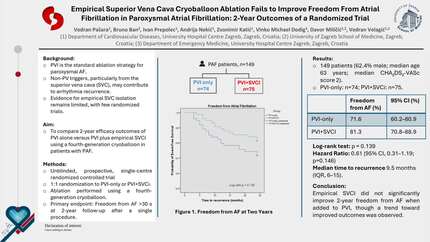
We designed an unblinded, prospective, single-center randomized trial, enrolling consecutive patients with PAF who were randomized in a 1:1 fashion to receive either standard cryoballoon PVI or PVI with additional SVCi. Primary efficacy endpoints were acute PVI, acute SVCi, and freedom from AF at a one-year follow-up. The safety endpoint was a composite of overall periprocedural complications.
A total of 149 patients (62.4% male; median age 63 years; median CHA2DS2-VASc 2) with paroxysmal AF were randomized (PVI-only: 74; PVI+SVCi: 75). Acute PVI was achieved in all patients in both groups. SVCi was achieved in 62 (84.9%) patients in the PVI+SVCi group, with impending right phrenic nerve palsy (PNP) or loss of sinus rhythm being the most common reasons for SVCi interruption (15.1%; N=13). There was no significant difference in major complications between the groups (0% vs 1.3%; p=0.157). One patient eventually received a permanent AAI pacemaker due to a sinus node injury. The PVI+SVCi group showed a higher rate of overall complications in comparison with the PVI-only group (32% vs 13.5%; p < 0.001), mainly due to the impending or transient right PNP. There were no persistent PNP cases. Bradycardia or junctional rhythm was observed during SVCi in 15 (20%) patients. At the end of the 12-month follow-up, the PVI+SVCi group showed a trend toward higher freedom from AF compared to the PVI-only group, although statistical significance was not reached (89.4% vs 79.8%; log-rank test p = 0.096).
Additional SVCi did not significantly improve freedom from AF at a one-year follow-up in comparison with conventional PVI by fourth-generation cryoballoon, and it was associated with a higher risk of periprocedural complications. Freedom from AF in PVI vs. PVI + SVCi

You may be interested in