Cardiovascular outcomes in patients with atrial fibrillation concomitantly treated with antiarrhythmic drugs and non-vitamin k antagonist oral anticoagulants
EP Europace Journal


Abstract
Limited data compared antiarrhythmic drugs (AADs) with concomitant non-vitamin K antagonist oral anticoagulants in atrial fibrillation patients, hence the aim of the study.
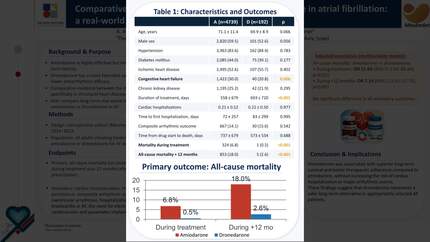
National health insurance database were retrieved during 2012–17 for study. We excluded patients not taking AADs, bradycardia, heart block, heart failure admission, mitral stenosis, prosthetic valve, incomplete demographic data, and follow-up <3 months. Outcomes were compared in Protocol 1, dronedarone vs. non-dronedarone; Protocol 2, dronedarone vs. amiodarone; and Protocol 3, dronedarone vs. propafenone. Outcomes were acute myocardial infarction (AMI), ischaemic stroke/systemic embolism, intracranial haemorrhage (ICH), major bleeding, cardiovascular death, all-cause mortality, and major adverse cardiovascular event (MACE) (including AMI, ischaemic stroke, and cardiovascular death). In Protocol 1, 2298 dronedarone users and 6984 non-dronedarone users (amiodarone = 4844; propafenone = 1914; flecainide = 75; sotalol = 61) were analysed. Dronedarone was associated with lower ICH (HR = 0.61, 95% CI = 0.38–0.99,
The use of dronedarone with NOACs was associated with cardiovascular benefits in an Asian population, compared with non-dronedarone AADs and amiodarone.
Contributors

Victor Chien-Chia Wu
Author
Chun-Li Wang
Author
Yu-Chang Huang
Author
Hui-Tzu Tu
Author
Yu-Tung Huang
Author
Chien-Hao Huang
Author
Shao-Wei Chen
Author
Chang-Fu Kuo
Author
Kuo-Chun Hung
Author
You may be interested in