Prasugrel-based de-escalation vs. conventional therapy after percutaneous coronary intervention in ACS patients according to the renal function
European Heart Journal


Abstract
Type of funding sources: Private company. Main funding source(s): A consortium of six companies in Korea (Daiichi Sankyo, Boston Scientific, Terumo, Biotronik, Qualitech Korea, and Dio).
Patients with coronary artery disease and impaired renal function are at higher risk for both bleeding and ischemic adverse events after percutaneous coronary intervention (PCI).
We assessed the efficacy and safety of a prasugrel based de-escalation strategy in patients with impaired renal function.
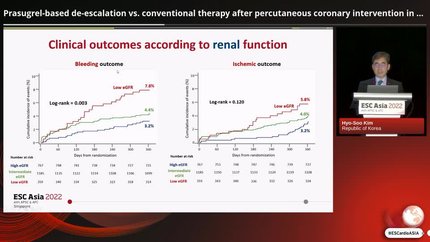
We conducted a post-hoc analysis of the HOST-REDUCE-POLYTECH-ACS study. Patients with available estimated glomerular filtration rate (eGFR) (n=2,311) were categorized into three groups. (high eGFR: ≥90 mL/min; intermediate eGFR: ≥60 and <90 mL/min; low eGFR: <60 mL/min). The endpoints were bleeding outcomes (Bleeding Academic Research Consortium type 2, or higher), ischemic outcomes (cardiovascular death, myocardial infarction, stent thrombosis, repeat revascularization, and ischemic stroke), and net adverse clinical events (all cause death, BARC 2 or greater bleeding, MI, stent thrombosis, repeat revascularization, and ischemic stroke) at 1 year follow-up. The hazard ratio (HR) and 95% Confidence interval (CI) were calculated from the multivariate Cox proportional hazard regression analysis. Covariates that were considered clinically meaningful were included. The probability risk ratio was obtained by dividing ischemic hazard function from the bleeding hazard function.
With respect to net adverse clinical events, prasugrel de-escalation was beneficial regardless of baseline renal function (p for interaction = 0.508). The relative reduction in bleeding risk from prasugrel de-escalation was higher in the low eGFR group compared with that from both the intermediate and high eGFR groups (relative reduction: 64% [HR 0.36, 95% CI 0.15–0.83] vs. 50% [HR 0.50, 95% CI 0.28-0.90] and 52% [HR 0.48, 95% CI 0.21-1.13] for low, intermediate, and high eGFR groups, p for interaction=0.646). Ischemic risk from prasgurel de-escalation was not significant in all eGFR groups ([HR 1.18, 95% CI 0.47-2.98], [HR 0.95, 95% CI 0.53-1.69], and [HR 0.61, 95% CI 0.26-1.39)], respectively, p for interaction=0.119). The probability risk ratio was highest in low eGFR group (1.06 vs. 1.26 vs. 1.36, for high, intermediate, and low eGFR groups, respectively, p for trend<0.001), suggesting higher relative bleeding risk above ischemic risk. Within those randomized to the de-escalation strategy, the mean probability risk ratio was not significantly different according to renal function (0.89, vs. 0.84 vs. 0.80 respectively, p for trend = 0.053), which was in contrast to those randomized to the conventional strategy where the mean probability risk ratio increased significantly as renal function decreased (1.24 vs. 1.67 vs. 1.94 respectively, p for trend<0.001).
The beneficial effect of prasugrel-based de-escalation strategy was consistent regardless of the baseline renal function, which was mostly driven by a reduction in bleeding risk which was greatest in those with low eGFR.
Contributors



You may be interested in